Guided OB Sweep · in field studies
Ultrasound where there is no sonographer.
The health worker follows six pictures. The scan travels to the hospital. A doctor reads it.
Why it matters
Two skills. We removed one from the clinic.
In many low-resource settings, women go through pregnancy without a single scan — often because there is no one trained to perform it. Training a sonographer takes years, because a sonographer does two hard things at once: finding the right view, and reading it.
Conventional scanning
Guided OB Sweep
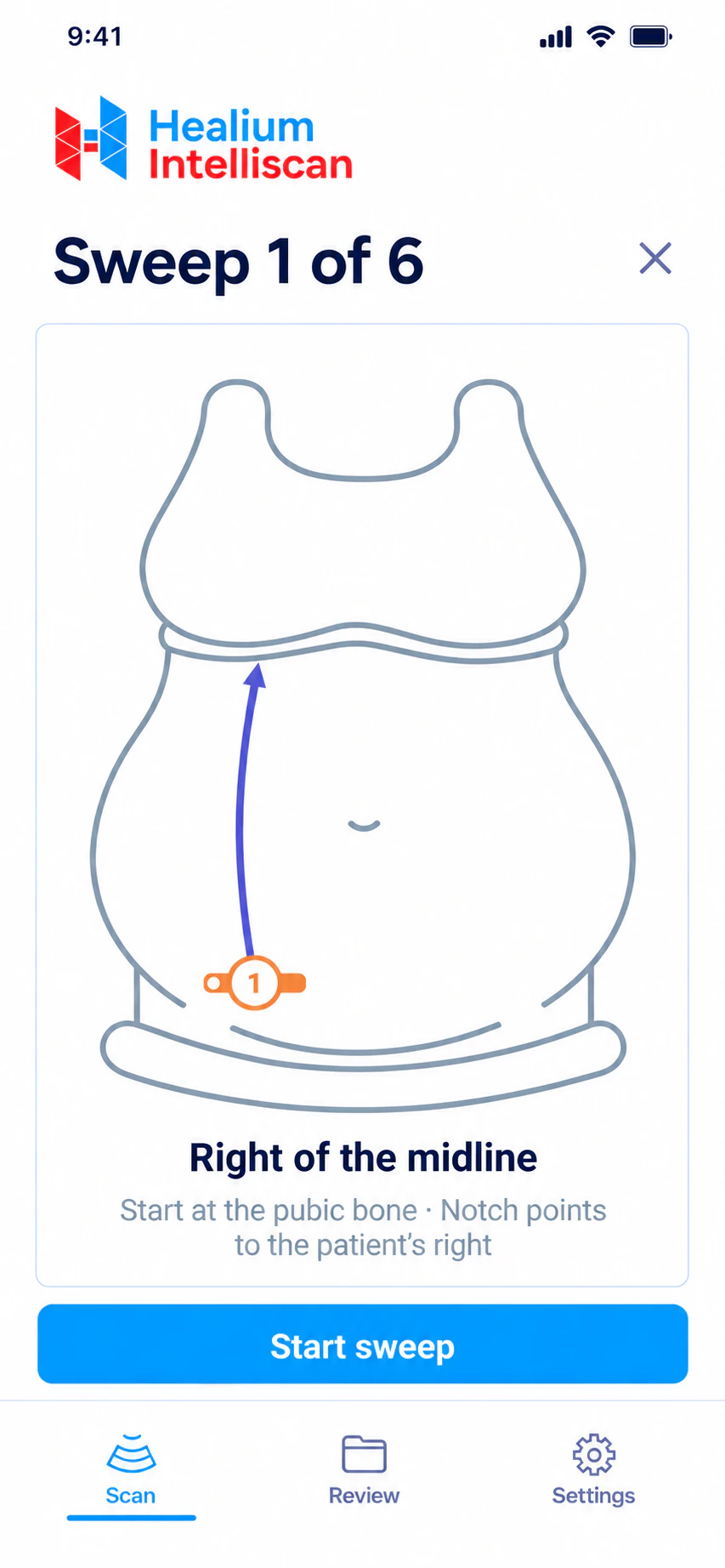
The health worker moves the probe along a fixed path she can feel with her hand — pubic bone, navel, hips, breast bone. She never interprets anything. The reading happens later, at the hospital, by someone qualified.
How it works
Four steps, one exam.
The six sweeps
Three up the body. Three across it.
What the six sweeps are for
- Is the pregnancy in the womb?
- How many babies?
- Which way is the baby lying?
- Where is the placenta?
- How much fluid is around the baby?
- Is there a mass in the pelvis?
Sweeps 1–3 run up the body; 4–6 run across it. Because the two directions cross, the sweeps are designed to capture the baby in any common position.
What happens to the scan
Captured in the village. Read in the city.
- At the clinicHealth worker scansSix guided sweeps
- On the phoneHeld offlineNothing is lost without signal
- When connectedUploads itselfOn Wi-Fi or mobile data
- At the hospitalStudy arrivesReady for a qualified reader
- AnywhereA doctor reads itReads the full sweep video
- Back at the clinicFindings returnTo the health worker
Built for the field
Everything the reader needs. Nothing the worker must judge.
- About 5 minutes per scan
- About 1 hour of protocol training
- 6 guided sweeps
- About 10 seconds each
- Checked before the patient leaves
What it is — and isn't
It captures. A doctor reads.
- It captures scans.It does not diagnose, measure, score or use AI. It checks that each sweep is usable — not that the baby is healthy.
- No image during the sweep.On purpose: the moment someone without sonography training can see the image, they start trying to read it and leave the path the method depends on.
- It doesn't replace the doctor.It moves the doctor's work off the clinic floor and onto a screen somewhere else.
- It's in field studies.Guided OB Sweep is being evaluated in field studies and is not part of the device's FDA-cleared indications for use.
- It isn't Sweep Guidance.Guided OB Sweep is a workflow in the Healium Intelliscan app: six pictured sweeps, no AI, and every scan read by a doctor. Sweep Guidance is a separate Healium Intelligence module in clinical evaluation.
Why a doctor reads it
Read by a doctor. Not guessed at the bedside.
Where it fits
Same probe. Same app.
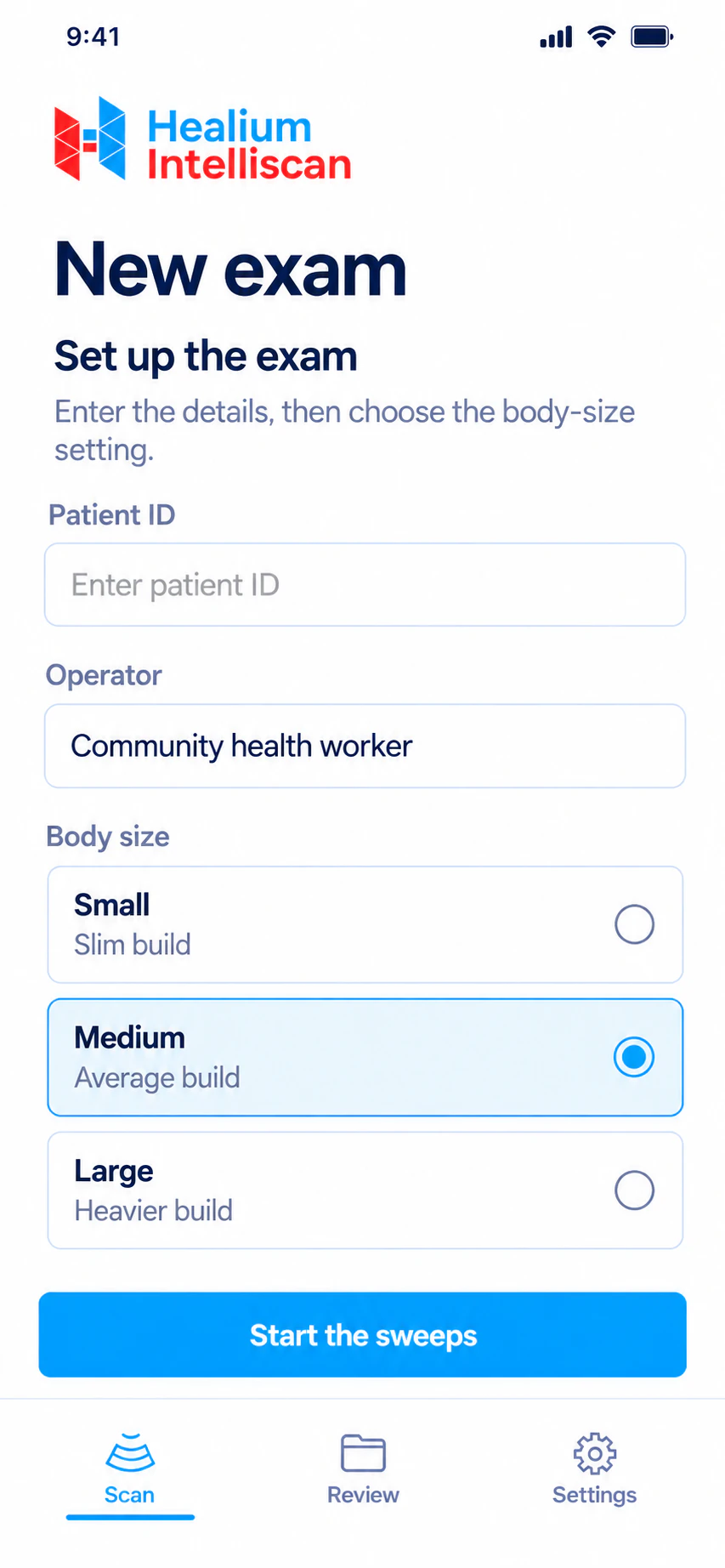
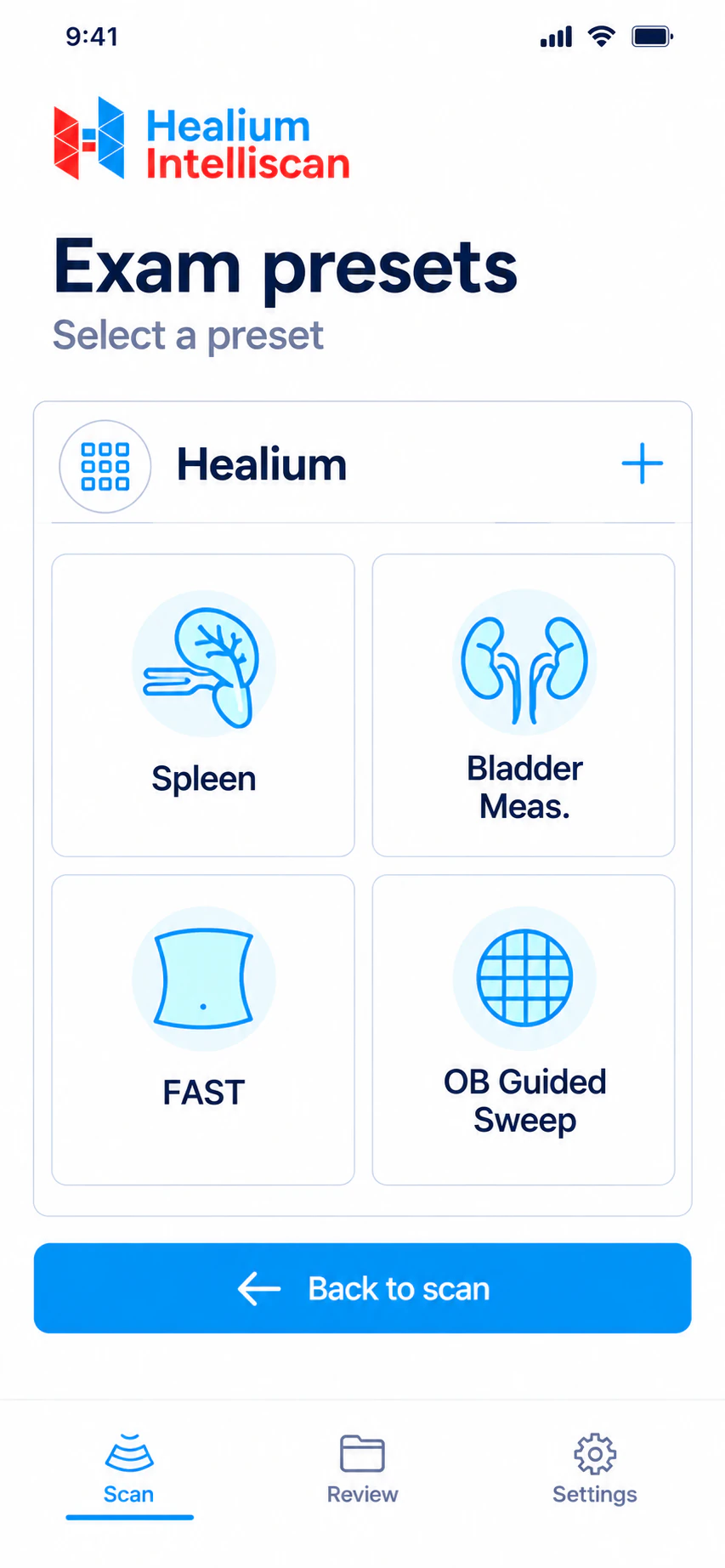
Guided OB Sweep is an acquisition mode inside the Healium Intelliscan app — not a separate product or a separate app to download.
- Probe
- Healium Intelliscan · convex array
- In the app
- Preset “OB Guided Sweep”
- Operator
- Nurse or midwife trained in the Guided OB Sweep protocol
- Reader
- A qualified doctor, at the hospital or remotely
For programmes
A programme, not just a probe.
For ministries of health, NGOs and hospital networks running antenatal care at scale.
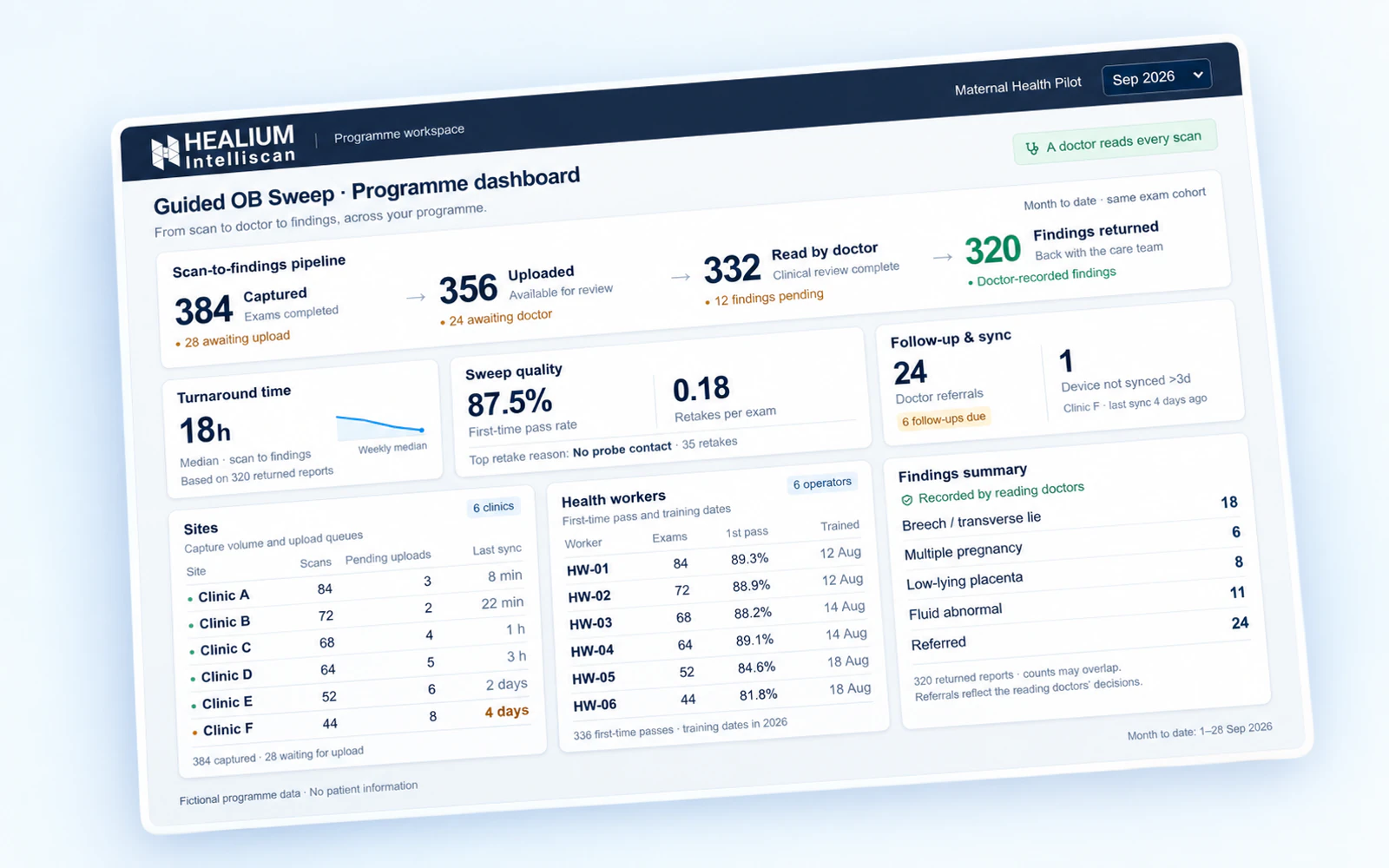
The programme dashboard
- Scan-to-findings pipeline: captured, uploaded, read by a doctor, findings returned
- Turnaround time from scan to findings
- Sweep quality and retakes, by site and by health worker
- Findings and referrals, as recorded by the reading doctors
Getting started
- About an hour of protocol training per health worker, in our field studies
- A reading pathway to your doctors, at the hospital or remotely
- Findings returned to the clinic
Partner with us
Bring Guided OB Sweep to your programme.
We're working with health programmes, hospitals and researchers on field studies. Tell us about your setting and we'll reply by email.